

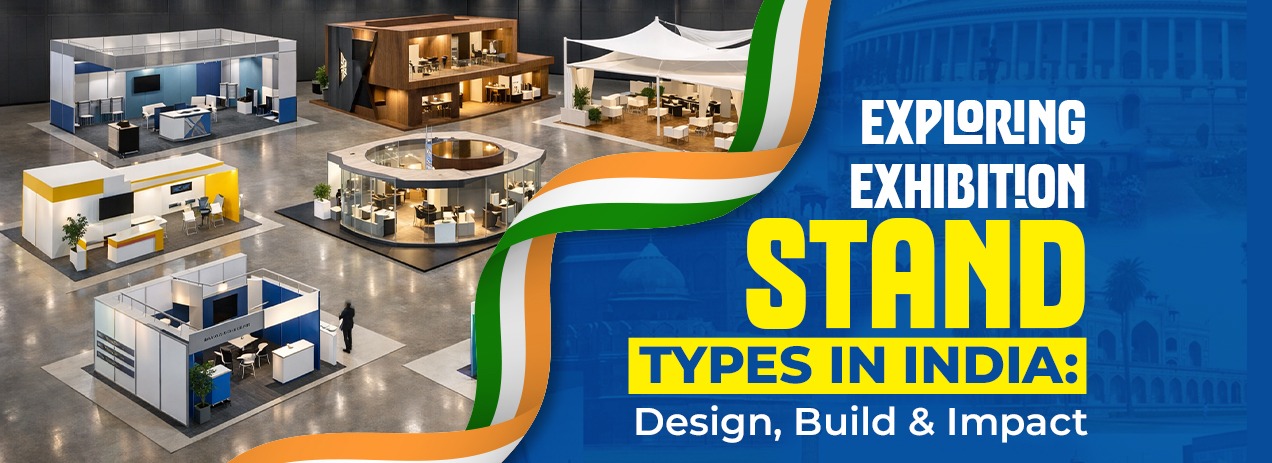
Exhibition stands across India aren’t one-size-fits-all solutions. Companies face a dynamic landscape where modular stands compete with elaborate custom installations, each serving distinct market needs. The decision-making process hinges on financial capacity, how frequently you participate in trade shows, your brand positioning, and the physical dimensions available. Success lies in aligning your stand choice with these core business variables.
India’s trade fair circuit showcases multiple standard exhibition booth models.
1. Modular Shell Booths:
Explanation: Elementary exhibition structures arranged by venue managers, built with uniform specifications including metal-polymer wall systems, ground covering, simple light fixtures, and basic identification signage.
Recommended for: Exhibition novices, small-scale operations, or cost-sensitive firms requiring no-fuss display zones.
Core advantages:
- Wallet-friendly option.
- Fast construction and dismantling.
- Limited design variations may hamper brand visibility.
2. Compact Display Stands:
Explanation: Convenient carry-on displays with minimal weight, featuring fold-away mechanisms for fast deployment and long-term reusability. Standard options include standing banners, accordion-style backdrops, and counter displays.
Recommended for: SMEs, businesses with active event calendars (brand activations, industry meets), or as enhancements to existing stand configurations.
Core advantages:
- Hassle-free portability across locations.
- Economical compared to fully customized builds.
- Straightforward setup without needing professionals.
- Excellent for cramped exhibition zones.
3. Customizable Modular Booths:
Explanation: Composed of pre-engineered, durable components like metal support systems, detachable surface panels, and textile branding that allow quick assembly and modification across different exhibition spaces and floor plans.
Recommended for: Brands exhibiting regularly that require adaptable, scalable, and long-lasting booth systems.
Core advantages:
- Remarkable flexibility and repeat-use potential.
- Clean and business-like aesthetic.
- More budget-friendly over multiple events versus unique constructions each time.
- Upgradeable with additions such as LED lighting, touchscreens, and counters.
4. Custom-Designed Exhibition Structures:
Explanation: Constructed custom to specification for a designated company and specific event. These exhibits are wholly personalized, representing the firm’s image, purpose, and business objectives while providing absolute design autonomy in terms of styling, construction materials, and incorporated elements.
Recommended for: Leading enterprises or high-caliber brands intending to generate remarkable, memorable experiences at flagship exhibitions.
Core advantages:
- Distinctive and unmatched creative execution.
- Commanding visual appeal and superior brand exposure.
- Facilitates complex additions including multi-story frameworks, private consultation rooms, demonstration stations, and innovative AV installations.
- Higher financial commitment requiring thorough blueprinting and extended lead times.
5. Dual-Approach Display Stands:
Explanation: Fuses standard modular frameworks with bespoke enhancements, using a foundational system structure while integrating custom-built accents for more imaginative and differentiated presentation.
Recommended for: Businesses pursuing the design liberty and personalized branding of custom stands while preserving the recyclable nature and partial cost savings of modular construction.
Core advantages:
- Malleable design reconfigurable for different occasions.
- Unites distinctive character with superior functionality.
- Blends the excellence of both innovation and sustainable use.
Stand Classifications Based on Floor Space Layout:
Beyond structural design, exhibition booths are further classified according to their location positioning on the trade show floor:
Linear Row Booths (Standard Inline):
These booths feature a single accessible front opening that directly faces the main walkway. The remaining three sides are enclosed by partition walls that are shared with adjacent exhibitors. This configuration creates a confined yet functional exhibition space. The open frontage serves as the primary point of visitor engagement and brand visibility.
Angular Exhibition Stands:
These booths occupy the end position within exhibition rows, offering exposure on two connecting sides. The advantageous placement delivers enhanced visibility as attendees approach from multiple walkways. Corner locations typically experience elevated pedestrian movement compared to mid-row positions. The two-sided openness creates more opportunities for visitor engagement and brand recognition.
Three-Sided Open Stands (Peninsula Layouts)
Accessible from three different directions while maintaining a single shared boundary with a neighboring booth. This premium configuration offers remarkable visual prominence and brand exposure throughout the venue. The open tri-sided layout presents extensive possibilities for imaginative architectural designs and spatial arrangements. Multiple access points facilitate smoother visitor flow and create diverse interaction zones within the stand.
Conclusion :
The diversity of exhibition stand options available in India ensures every business can find a suitable solution. Your choice should align with company size, budget limitations, and long-term exhibition plans. Whether prioritizing affordability, flexibility, or visual impact, there’s a stand type designed for your requirements. Investing in the right exhibition stand strengthens your brand presence and maximizes trade show success.